
Transcript
Announcer:
Welcome to CE on ReachMD. This activity is provided by Prova Education. This episode is part of our MinuteCE curriculum.
Prior to beginning the activity, please be sure to review the faculty and commercial support disclosure statements as well as the learning objectives.
Dr. Richter:
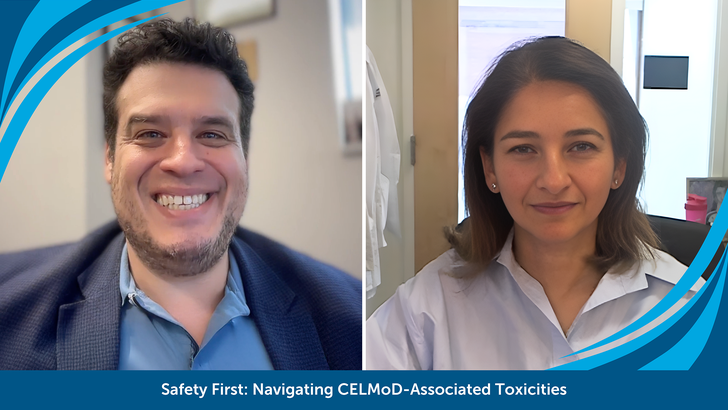
This is CME on ReachMD. I'm Dr. Joshua Richter. Here with me today, is Dr. Noopur Raje, and today we'll be talking about CELMoD-associated toxicities. We'll start with a brief discussion about what CELMoDs are.
Noopur, you’re up. Help us out.
Dr. Raje:
Thank you so much, Josh. So CELMoDs are a novel class of immunomodulatory drugs. We’re all very familiar with lenalidomide and pomalidomide, and this is a next generation of these same immunomodulatory drugs. They target a protein known as cereblon E3 ligase modulator, and by doing so, cause killing of your myeloma cells. But what's really interesting and exciting is they're also very potent T cell augmenters, so they are able to reverse T cell exhaustion; they're able to increase NK cell activity.
And the fact that these are oral drugs, they are actually very easy to combine with some of our backbone drugs like the proteosome inhibitors, carfilzomib as well as bortezomib, as well as some of the anti CD38 monoclonal antibodies like daratumumab. Given that we can give these orally, they're easy to work with with all of these drugs. And with every new iteration of the immunomodulatory drugs, what we have begun to see is decreased amounts of toxicities. So the off-tumor, on-target toxicities of these immunomodulatory drugs like skin rashes, diarrhea, etc., as we've gotten better at getting these newer more novel CELMoDs, we're seeing less and less of these toxicities.
So in general, these oral CELMoDs, like iberdomide and mezigdomide, are extremely well tolerated. We don't see the typical skin rashes that you're used to seeing with lenalidomide and pomalidomide. You don't see the same level of GI toxicity that you see specifically with lenalidomide. We do see some hematologic toxicity with all of these CELMoDs, and most of it is neutropenia, anemia, and thrombocytopenia. And with these, obviously, it does predisposed patients to infections, so it's really important that while they are on a CELMoD, we monitor for some of these toxicities. And with these toxicities, it's really important that we prophylax patients appropriately. So mainly, for hematologic toxicities, such as neutropenia, I’ve been using growth factor judiciously is really important, so that you can continue to keep people on drugs like mezigdomide and iberdomide.
Again, as with all other IMiDs, there is a risk for thrombosis. So in general, whenever a patient is on a CELMoD, we would recommend some thrombosis prophylaxis. The majority of patients are on aspirin alone. Obviously, if a patient has a higher risk of thrombosis, we do encourage the clinicians to put them on anticoagulation as well.
The other toxicities that I talked about, like diarrhea and rashes, are very rare. But if they occur, we would manage it very similar to how we manage it with the other IMiDs, such as with lenalidomide and pomalidomide.
Dr. Richter:
So I think that's an amazing framework to really help get our community colleagues on board with using the CELMoDs. And I think although one thing that you expertly pointed out is that there are some differences between the CELMoDs and the IMiDs, there also are some similarities. And I think over the years, we have all, collectively as a community, learned to deal with some of the hematologic toxicities and GI toxicities of these drugs. So it’s really nice to have a brand-new drug enter our armamentarium with already the ingrained knowledge of how to manage some of the more common toxicities.
But with that, our time is up. Thank you so much for listening.
Announcer:
You have been listening to CE on ReachMD. This activity is provided by Prova Education and is part of our MinuteCE curriculum.
To receive your free CE credit, or to download this activity, go to ReachMD.com/Prova. Thank you for listening.

